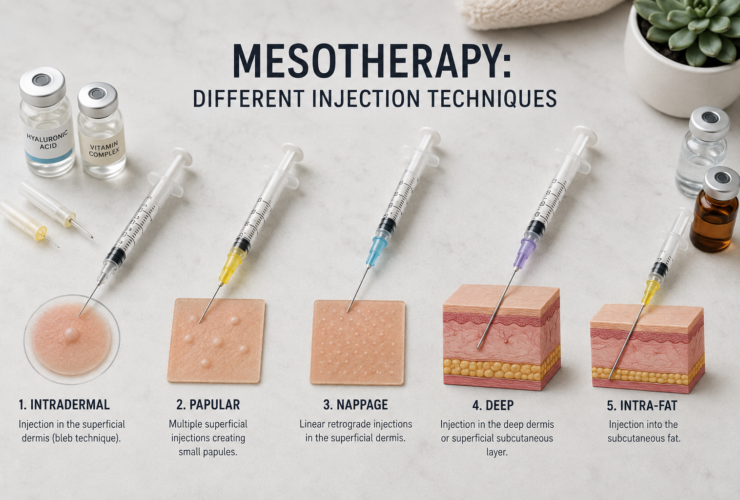



Combining Mesotherapy With Other Aesthetic Treatments: The Pros and Cons.
Society of Mesotherapy of the United Kingdom
SoMUK — Member Article
Combining Mesotherapy With Other Aesthetic Treatments: The Pros and Cons
Mesotherapy is rarely used in true isolation in modern aesthetic practice. What does the evidence actually say about combining it with toxin, fillers, and energy-based devices — and where should members exercise caution?
Few patients today present for a single, isolated treatment. A typical aesthetic consultation increasingly results in a combined plan — mesotherapy alongside botulinum toxin, dermal filler, or an energy-based device, sequenced across one or several sessions. The evidence base for this combined approach has grown substantially, but so has the need for clear-eyed thinking about where combination genuinely adds value, and where it adds risk without a corresponding benefit.
Why Combination Has Become the Norm
The clinical logic behind combining modalities is straightforward: different treatments address different mechanisms of facial and skin ageing, and no single modality addresses all of them well. Botulinum toxin reduces dynamic muscle activity; dermal fillers restore lost volume and structural support; mesotherapy improves skin quality, hydration, and microcirculation at the dermal level. A published clinical experience associating anti-ageing mesotherapy, hyaluronic acid fillers, and botulinum toxin within a single treatment philosophy describes exactly this rationale — using each modality for the mechanism it addresses best, rather than asking one treatment to do work it isn’t suited for.
The Case For Combination
Real comparative evidence exists, not just clinical impression
A multicentre, randomised, evaluator-blinded study compared non-cross-linked hyaluronic acid compound filling plus mesotherapy against botulinum toxin A for horizontal neck lines — a concern where energy devices and toxin alone have shown limited efficacy. This is a genuinely useful example of combination addressing a clinical gap that no single modality fills well on its own, rather than combination for its own sake.
Systematic review support for combining biostimulators with other modalities
A 2025 systematic review examined the effectiveness and safety of combining biostimulators with botulinum toxin, dermal fillers, and energy-based devices, concluding that combined approaches are hypothesised to provide more sustained overall improvement than monotherapy — while explicitly noting that evidence on long-term efficacy and safety is still limited and continues to evolve. Members should communicate this evidence honestly: directionally positive, but not yet definitive.
Expert consensus supports sequencing, not simultaneous treatment
An expert consensus statement on combined aesthetic interventions using botulinum toxin, fillers, and energy-based devices concluded that optimal treatment begins with thorough assessment and an individualised plan, and recommends spacing consecutive treatments one to two weeks apart to allow resolution of side effects and accurate assessment of results before the next intervention. This is a meaningful clinical detail: the consensus is not for simultaneous combination within a single sitting as a default, but for a planned, sequenced approach.
The Case for Caution
Cumulative injection burden is a recognised risk factor
A retrospective study of complications following dermal injectables found the most common adverse events were biofilm formation and chronic immune reactions, followed by abscesses, Tyndall effect, vascular occlusion, and filler migration — with over half of the implicated products being uncertified or of unknown origin. While this study examined filler complications specifically rather than combination treatment directly, it underscores a principle directly relevant to combining modalities: every additional puncture, product, and injection site adds to a patient’s total procedural exposure, and risk does not necessarily stay constant as that exposure increases.
Vascular complications remain the most serious risk category
Vascular events — whether from intravascular embolism or extravascular compression of surrounding vessels — remain the most consequential complication associated with injectable treatment, with outcomes ranging from localised tissue necrosis to, in rare cases, vision loss. When multiple injectable modalities are used in proximity, anatomical risk does not simply add together in a predictable way; it requires the practitioner to hold a complete, current mental map of every product and technique used in that area, not just the one currently being administered.
Evidence for combination is encouraging, but still immature
It bears repeating, since it is easy to lose in enthusiasm for combination protocols: the same 2025 systematic review supporting combined approaches explicitly flags that long-term efficacy and safety data remain limited. Encouraging early evidence is not the same as an established, fully evidence-based standard, and members should hold that distinction clearly when counselling patients.
At a Glance
Supports combination
- Addresses multiple ageing mechanisms simultaneously rather than asking one modality to do all the work
- Direct comparative trial evidence exists for specific indications (e.g. neck lines)
- Systematic review evidence suggests more sustained overall improvement
- Expert consensus exists supporting a structured, sequenced approach
Warrants caution
- Cumulative injection burden may increase total complication risk
- Vascular risk requires a complete anatomical picture across all products used, not just the current one
- Long-term efficacy and safety evidence for combined protocols remains limited
- Simultaneous, same-session combination is not the consensus-recommended default
A practical recommendation
Where a combined plan is clinically indicated, the current expert consensus favours a staged approach — sequencing treatments roughly one to two weeks apart rather than combining multiple injectable modalities within a single session as a default. This allows side effects to resolve, results to be properly assessed before adding a further intervention, and any complication to be attributed correctly to its source rather than confused among several recent treatments.
Clinical and Practice Implications for Members
Combination treatment plans should be built around a specific clinical rationale for each modality included, not assembled simply because multiple treatments are available or popular. Before adding mesotherapy to an existing toxin or filler plan, or vice versa, members should maintain a complete record of every product, site, and technique used in the treatment area, regardless of when each was administered, and should counsel patients honestly that combined-protocol evidence, while encouraging, is not yet at the same maturity as evidence for individual modalities used alone. Where simultaneous same-session combination is considered, the anatomical and cumulative-risk reasoning should be explicit in the clinical record, not assumed.
Conclusion
The evidence supports combining mesotherapy with other aesthetic modalities as a genuinely useful clinical strategy in many cases, particularly where different treatments are addressing genuinely different ageing mechanisms. It does not yet support combination as a default, evidence-equivalent alternative to careful, sequenced, individually-justified treatment planning. The Society’s position remains consistent with our broader approach to evidence: real benefit where it exists, communicated honestly, with the same rigour applied to combination protocols as to any single mesotherapy indication.
References
- Hyaluronic Acid Compound Filling Plus Mesotherapy vs Botulinum Toxin A for the Treatment of Horizontal Neck Lines: A Multicenter, Randomized, Evaluator-Blinded, Prospective Study in Chinese Subjects. Aesthet Surg J.
- Advantages of combined therapies in cosmetic medicine for the treatment of face ageing: botulinum toxin, fillers and mesotherapy. Ann Chir Plast Esthet.
- Webb WR. A systematic review on the effectiveness and safety of combining biostimulators with botulinum toxin, dermal fillers, and energy-based devices. 2025.
- Consensus Recommendations for Combined Aesthetic Interventions in the Face Using Botulinum Toxin, Fillers, and Energy-Based Devices. Dermatol Surg.
- Complications of Dermal Injectables — A Retrospective Study. J Cosmet Dermatol. 2025.
- Adverse Effects Associated with Dermal Filler Treatments: Part II Vascular Complication. J Pers Med (MDPI). 2024.
- Biofilm formation is a risk factor for late and delayed complications of filler injection.
The Society of Mesotherapy of the United Kingdom (SoMUK)
22 Harley Street, Suite 8-8a, London W1G 9PL
contact@somuk.co.uk