

The Injection Techniques

The Injection Techniques of Mesotherapy: Matching Method to Indication
Mesotherapy is often described by the products it delivers — vitamins, hyaluronic acid, amino acids, peptides, growth factors. Yet any experienced practitioner knows that the
technique
of injection is at least as important as the solution in the syringe. The same product, delivered at the wrong depth, angle or spacing, produces a different result — and a different safety profile. Mastering the classical techniques, and knowing when to choose each one, is what turns a good injector into a confident clinician.
This guide sets out the principal manual techniques used in mesotherapy, the depth and angle each requires, and the indications each one suits best. It is written for registered healthcare professionals and is intended as an educational overview, not a substitute for hands-on, supervised training.
The three variables that define every technique
Whatever name a technique carries, it is defined by three controllable variables: the
depth
of deposit (from the epidermis at a fraction of a millimetre down to the deep dermis or hypodermis), the
angle
of the needle to the skin (from near-flat to perpendicular), and the
volume and spacing
of each microdeposit. Control these three and you control the outcome. Most practitioners work with a 4–6 mm 30G or 32G needle, either by hand or with a mesotherapy device, and the finest results come from consistency rather than speed.
| Technique | Angle | Depth | Best suited to |
| Epidermal | ~10–15° | <0.5 mm | Very superficial, low-irritation delivery; sensitive areas |
| Papule (IDP) | ~20–30° | ~1–2 mm | Targeted deposits; periorbital, precise correction |
| Nappage | ~30–60° | ~1–2 mm | Even coverage; mesolift, skin glow, overall quality |
| Point-by-point | ~90° | ~2–4 mm | Deeper, larger deposits; scalp, cellulite, focal areas |
| Retrograde threading | Low, along skin | Linear, dermal | Larger zones, scalp lines; needle or cannula |
Nappage: the technique of the mesolift
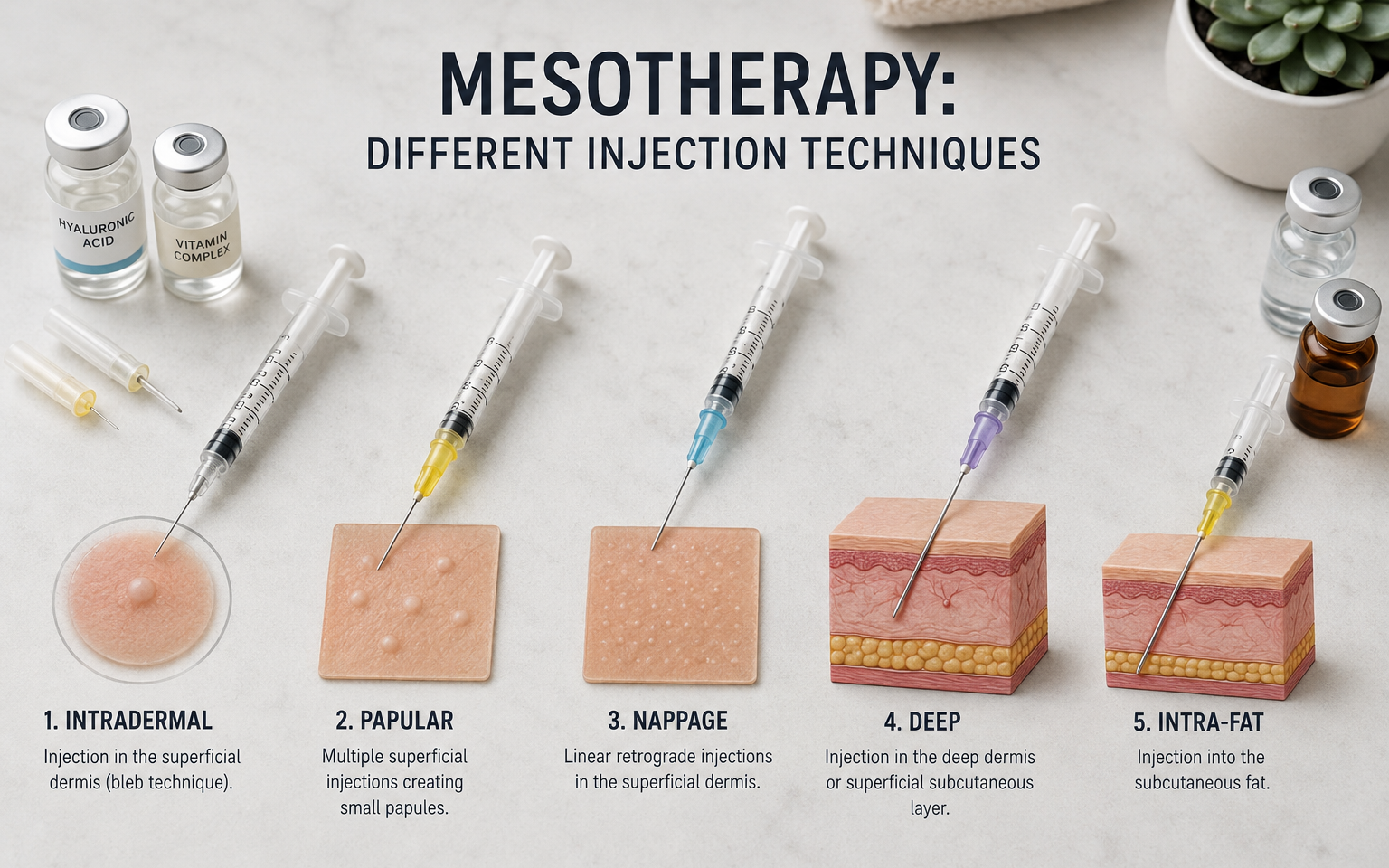
Nappage (from the French for a “coating”) is the signature technique for skin-quality work. The needle is held at roughly 30–60° and moved in a rapid, sweeping series of superficial pricks a few millimetres apart, each depositing a minute amount of solution at around 1–2 mm. The aim is an even, sheet-like distribution across the treatment zone rather than concentrated depots. It is the workhorse of the mesolift and of general skin-brightening protocols, giving diffuse coverage with a light footprint. It demands rhythm and a steady hand; done well it is fast and comfortable, done poorly it is uneven and bruises easily.
The papule technique: precision and retention
Where nappage spreads product broadly, the intradermal papule technique concentrates it. The needle enters the superficial dermis at a shallow angle and a small, defined volume is deposited to raise a visible bleb, or papule. Because the product sits in a discrete pocket it is released slowly and stays where it is placed — ideal for targeted areas such as the periorbital region or for correcting a specific zone. The trade-off is speed and visible marks: papules take longer to place and leave small raised points that settle over the following hour or two. It is a precise, deliberate technique that rewards anatomical knowledge.
Point-by-point: depth and dose
The point-by-point (or simply “point”) technique uses a near-perpendicular needle to place single, larger deposits at defined, spaced injection points, reaching the deeper dermis at around 2–4 mm. It is the method of choice where a greater volume needs to reach a deeper target — scalp protocols for hair, or body work on cellulite and localised adiposity, where deeper deposits into the appropriate plane are required. Spacing and depth control are everything here: too superficial wastes the depth advantage, too deep or too fast raises the risk of bruising and discomfort.
Epidermal and retrograde threading
The epidermal technique keeps the needle almost flat for the most superficial delivery of all — useful for very sensitive skin or where minimal penetration is wanted. Retrograde linear threading, by contrast, inserts the needle (or a cannula) along a line and deposits product steadily on withdrawal, covering larger zones efficiently and, with a cannula, reducing trauma and vascular risk over broader areas such as the scalp. Neither replaces the core three techniques, but both extend the practitioner’s options when the anatomy or the indication calls for it.
nappage, with papules for targeted zones.
Hair & scalp:
point-by-point or nappage into the scalp at appropriate depth.
Cellulite & localised fat:
deeper point-by-point into the correct plane.
Delicate areas (periorbital):
shallow papule technique, placed with care.
Technique is a safety decision, not just an aesthetic one
Depth and angle are not only about efficacy; they govern the risk of bruising, discomfort and inadvertent injury. Sound aseptic technique, careful patient selection and screening, a working knowledge of the relevant anatomy and vasculature, and honest management of expectations all sit alongside needle skill. Consistency — the same depth, the same spacing, the same rhythm — is what makes a treatment both effective and reproducible. This is precisely why supervised, hands-on training matters: these techniques are learned in the hand, not on the page.