


Mesotherapy in the Management of Acute and Chronic Pain
So
MUK
Mesotherapy in the Management of Acute and Chronic Pain
A review of current evidence, proposed mechanisms of action, and practical implications for members incorporating mesotherapy into pain management practice.
Mesotherapy is most widely recognised, particularly in the UK, as an aesthetic technique. Its clinical origins, however, lie elsewhere — and the evidence base supporting its therapeutic use in pain management has grown substantially in recent years.
Introduction
The term was coined in 1958 by the French physician Dr Michel Pistor to describe the intradermal injection of pharmacological agents for the treatment of localised pain, and the technique’s early decades of use were overwhelmingly therapeutic rather than cosmetic. As mesotherapy’s aesthetic applications have grown more prominent over the past three decades, this original pain-management indication has, in many markets, become the less visible half of the discipline.
That balance is shifting back. A 2025 international, multidisciplinary consensus guideline on mesotherapy — drawing on a literature review spanning 1976 to 2023 and structured around 23 clinical questions using PICO methodology — concluded that mesotherapy has accumulated sufficient evidence to support its use across osteoarticular pain, rehabilitation, and dermo-aesthetic indications, describing the field as moving decisively from a practice
“based on personal beliefs”
toward one grounded in evidence-based recommendations.
Mechanism of Action
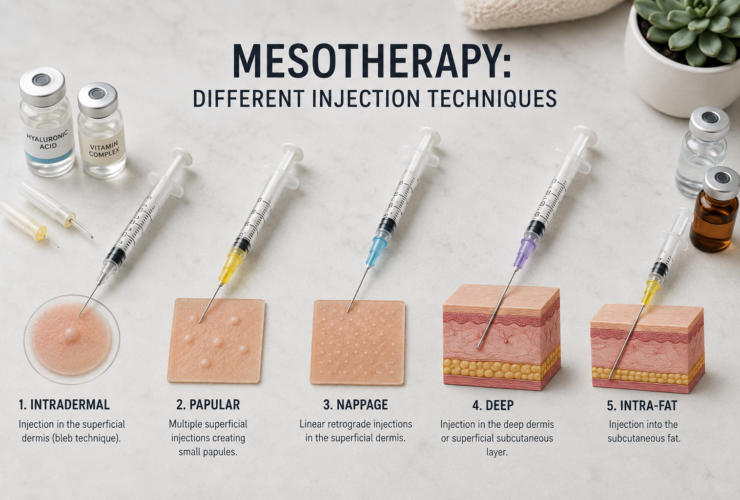
Mesotherapy for pain is more accurately described, in much of the recent literature, as
local intradermal therapy (LIT)
— a term proposed to emphasise that the clinical effect is achieved through superficial, dermal-layer inoculation rather than deeper or systemic drug delivery.
Modulated drug kinetics
An intradermal microdeposit alters the kinetics of the injected agent, slowing absorption and prolonging local action. This underlies mesotherapy’s drug-sparing effect: a retrospective comparison of cervicobrachial pain patients receiving standard versus halved drug concentration found comparable clinical outcomes, supporting the principle that a lower dose can achieve a clinically useful result.
Microcirculatory stimulation
Multiple closely spaced superficial injections near small vessels in affected tissue are theorised to stimulate microcirculatory change directly, independent of the pharmacological agent — relevant in chronic venous disease and congested, hypomobile soft tissue.
Mechanical and neurosensory effects
Multiple superficial micro-injections produce mechanical distension of surrounding tissue and stimulation of sensitive dermal fibres, with some authors proposing a contribution from dermally-mediated modulation of the intradermal glial cell system in pain control — consistent with early twentieth-century work on the analgesic effect of sterile water inoculation near a pain site, independent of any pharmacological agent.
In practice, most clinical mesotherapy for pain likely benefits from a combination of these mechanisms rather than any single one in isolation, and the Society encourages members to communicate this nuance accurately rather than overstating any one proposed pathway as definitively established.
The Evidence Base: Chronic Pain
Chronic back pain
has the most substantial body of evidence within musculoskeletal mesotherapy. A 2025 narrative review analysing nine studies and more than 800 patients with chronic back pain syndrome found a consistent positive impact on both pain reduction and functional improvement, with no serious adverse events reported. The review describes an emerging
three-step approach
: risk factor assessment, medical intervention via mesotherapy, and subsequent, targeted physiotherapy.
Musculoskeletal disorders more broadly
were the subject of a systematic review with meta-analysis restricted to high-quality randomised controlled trials. Across seven studies meeting inclusion criteria, a statistically significant reduction in Visual Analogue Scale pain scores was observed in the mesotherapy group compared with control in all but one trial. The authors note a meaningful secondary benefit: earlier pain relief may allow earlier patient access to physiotherapy and occupational therapy.
Knee osteoarthritis
has been examined in a randomised controlled trial of 43 patients (56 knees) with mild-to-moderate disease, comparing mesotherapy against saline control — contributing to a still-developing but clinically meaningful evidence base, of particular relevance given the population-level burden of knee osteoarthritis.
Cervicobrachial and neck pain
has been studied using diclofenac sodium and lidocaine injected into the trapezius over a six-week protocol, assessed via Visual Analogue Scale, range of motion, and objective muscle tone measurement using myotonometry — a model for the more rigorous, objectively-measured protocol design the Society encourages members to adopt where feasible.
The Evidence Base: Acute and Post-Acute Pain
Mesotherapy’s evidence base in genuinely acute pain is less extensive than in chronic musculoskeletal indications, but a relevant body of work has emerged around
post-acute and subacute pain syndromes
, most notably post-COVID pain syndrome. A retrospective cohort study of 96 patients with both nociceptive and neuropathic pain components found mesotherapy to be an easily applicable, cost-effective, and well-tolerated intervention, with a favourable side-effect profile relative to systemic alternatives.
Members should note that
acute nonspecific neck pain
has also been studied using single intracutaneous injections of local anaesthetic and steroid in a randomised controlled design, supporting feasibility in genuinely acute presentations, though this remains a comparatively narrow slice of the acute pain literature.
Safety Profile
A consistent theme across the reviewed literature is a favourable safety profile, with the chronic back pain review noting no serious adverse events across more than 800 patients. The technique’s drug-sparing rationale is itself a relevant safety consideration, particularly where the alternative would involve repeated systemic NSAID or steroid dosing.
A caution worth reinforcing
Data on potential interactions between co-injected pharmacological agents, and on the activity of skin cytochromes in modulating injected compounds, remain limited. Existing guidance specifically recommends
avoiding intradermal pharmacological mixtures combining multiple drug classes
, or drugs combined with herbal or other active substances, given the absence of robust data on drug-drug interaction, metabolic pathway activation, or photosensitivity risk at the intradermal level.
Limitations of the Current Evidence
The Society considers it important to state these plainly.
Standardisation remains incomplete
: protocols vary considerably in injection site, drug combination, dosing, and session frequency.
Trial quality is uneven
, with many studies retrospective, small, or lacking a control group.
Mechanism remains incompletely established
, with no single pathway definitively isolated as dominant.
Clinical and Practice Implications for Members
Chronic back pain and musculoskeletal pain currently represent the indications with the strongest supporting evidence, and framing mesotherapy within a structured, multidisciplinary pathway is consistent with current best-practice thinking. Where multiple agents are considered for a single injectate, the current absence of robust intradermal drug-interaction data warrants caution. Patients should be counselled honestly about the maturity of the evidence base, and members should avoid presenting mesotherapy as a definitively superior alternative to established first-line care where such claims are not yet supported.
Conclusion
Mesotherapy’s origins in pain management predate its now more widely recognised aesthetic applications, and the evidence accumulated since supports a genuine, if still maturing, clinical role for the technique in modern pain practice. The Society’s position is that this evidence should be communicated with the same standard of accuracy and proportion expected across all applications of mesotherapy: real benefit, honestly described, without overstatement.
References
- International Consensus Guidelines on the Safe and Evidence-Based Practice of Mesotherapy: A Multidisciplinary Statement.
J Clin Med.
2025;14(13):4689. - The role of mesotherapy in chronic back pain syndrome: what do we know?
Rheumatol Int.
2025;45(9):206. - Safety and efficacy of mesotherapy in musculoskeletal disorders: a systematic review of randomized controlled trials with meta-analysis.
PMC. - Efficacy of mesotherapy for pain, function and quality of life in patients with mild and moderate knee osteoarthritis: a randomized controlled trial.
PMC. - Effectiveness of mesotherapy in post-COVID pain syndrome: retrospective cohort study of 96 patients.
ScienceDirect.
2024. - Effects of intradermal therapy (mesotherapy) on bilateral cervicobrachial pain.
J Pers Med (MDPI).
2024;14(1):122. - Intradermal therapy (mesotherapy): the lower the better.
PubMed.
2022. - Mammucari M, et al. Mesotherapy: from historical notes to scientific evidence and future prospects.
Sci World J.
2020. - Mammucari M, et al. Role of mesotherapy in musculoskeletal pain: opinions from the Italian Society of Mesotherapy.
Evid Based Complement Alternat Med.
2012.